
i-SCAN Method
Confirm that your business idea is worth building,
before spending time and money creating an MVP or talking to customers
Validate your business idea with the i-SCAN Method
The i-SCAN Method is designed mainly for solo founders who want to bootstrap their venture and want to confirm the soundness of their business ideas, before spending time and money building it – though experienced or no solo founders can benefit from it too. This is not a method for founders chasing venture capital or planning to scale past product-market fit.
The goal is simple: find the problems that kill ventures before they cost you anything. That way, founders don’t waste time and money talking to customers or building MVPs nobody wants.
It’s far better to spend a couple of days finding out if your idea has fundamental structural problems, than to spend six months building and pouring money into a product that was never set up to succeed.
Most existing frameworks assume you already have a validated idea and jump straight to customer interviews, MVPs, or Lean Startup cycles. i-SCAN works one step earlier: it evaluates whether the idea itself is structurally sound, and whether it fits the specific founder trying to build it, before either has been tested with a single real customer.
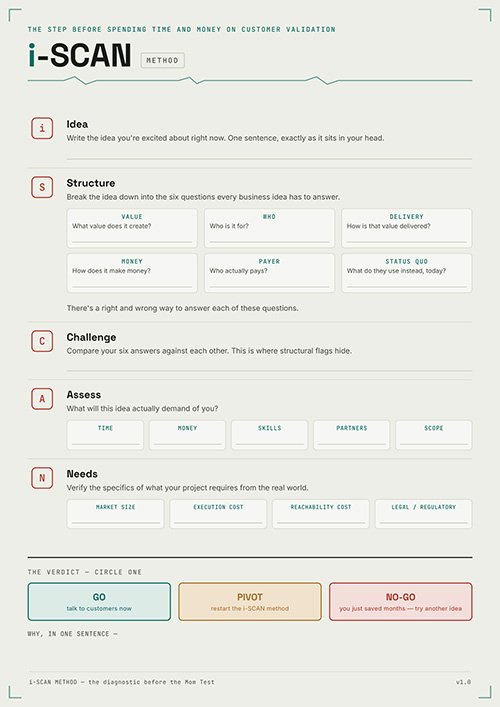
Before diving into how the i-SCAN Method works, here’s the i-SCAN One-Pager Canvas — a quick visual summary of the entire framework.
Overview of the i-SCAN Method
Bellow is a high-level overview of the framework displayed above.
The i-SCAN Method is a structural stress-test for business ideas designed to evaluate their operational demands against a founder’s actual limitations, such as time, money, skills, and partnerships, before they invest in building a Minimum Viable Product (MVP).
Founders most common (and dangerous) illusions:
- Thinking that the product is so unique, they don’t have competition, which only mean poor research or no market for the product or service.
- Believing a good product will grow automatically without any additional action to get traction.
- Assuming general business rules do not apply to them, because they are perfect or different.
- Relying purely on the hope that a final tweak in the product or service will finally bring traction, and
- Acting with false urgency out of fear that their idea will be stolen, spending time on everything except doing a proper idea evaluation
The Six Fundamental Questions
To build a good structured hypothesis for a business idea, founders must answer six core questions:
What value is provided?
This identifies the core human motivation or the specific pain the product relieves, rather than just listing its features.
- What the customer gains or stops suffering — from their perspective
- The primary Core Value Driver — ideally visible in the answer
Who receives the value?
Users should be defined by their behaviors and motivations rather than basic demographics.
- A behavioral description — what this person does and why, not just demographics
- Their specific motivation or pain
How is the value delivered?
This requires a detailed description of the user experience and delivery mechanism, not just naming a platform.
- The specific channel through which the customer accesses the solution
- How the customer experiences that delivery
How is the value captured as revenue?
This defines the pricing mechanism and what the price signals about the product’s market positioning.
- The revenue mechanism — per unit, subscription, commission, advertising
- The pricing positioning — what category it signals
Who pays?
In many business models, such as marketplaces, the user and the paying customer are entirely different people.
- Whether same as user or different
- If different — who pays, why they pay, and whether the two sides of your model depend on each other
What is the current alternative to resolve the pain?
This identifies what workarounds customers currently use and evaluates the “switching cost” required to make them change their behavior.
- Specific current alternative
- Switching cost
Core Value Drivers
Customers purchase products based on what the product does for their lives.
B2C (Business-to-Consumer): There are ten universal drivers, such as saving money, saving time, gaining status, avoiding risk and more. Startups should focus mainly on one primary driver initially so they do not dilute their message.
B2B (Business-to-Business): Purchasing involves multiple organizational roles, each with different primary drivers like ROI, career advancement, or organizational risk avoidance. A successful B2B startup must satisfy these various stakeholders simultaneously without creating internal conflicts.
Problem Validation and AI
A problem is only worth solving if it is “active,” meaning people are already using alternative workarounds but are highly unsatisfied with them.
Founders should not use Artificial Intelligence to ask if an idea is good, as AI will respond with a compliance bias.
Instead, founders should use AI to translate their product into specific user frustrations and then use precise prompts to search the internet for real-world evidence of people complaining about those exact issues.
The Five Structural Flags
When analyzing the six fundamental questions together, founders may uncover fatal structural contradictions:
Flag 1: The user and the payer are different people, which requires massive capital or strategic alliances to overcome the “chicken and egg” problem.
Flag 2: The product’s value relies on the user adopting a behavior or habit that does not currently exist.
Flag 3: The delivery of the product depends entirely on a third party that the founder does not control, such as an algorithm or API.
Flag 4: The business model only makes money at a massive scale, creating a dangerous “valley of death” with zero initial revenue.
Flag 5: The mental, behavioral, or financial switching cost is higher than the actual value the new product creates for the user.
Resolution and Final Checks
The severity of these structural flags is categorized into a traffic light system (Red, Orange, Yellow, Green) based on the founder’s available resources and willingness to solve them.
Founders can use their time and money to acquire necessary skills or partners, and if resources are insufficient, they can reduce or modify the project’s scope.
Before building anything
Before building anything, the founder must be aware of external facts. This includes:
- Calculating a realistic market size.
- Cost to build the product.
- Cost to acquire customers.
- Legal or regulatory hurdles.
Verdict
Finally, with all the information you have at this point, you can make a decision
- Go – You can jump to customer validation, with a much better-defined hypothesis.
- Pivot – You can modify your value offering, value proposition, or customer segment, and if necessary, re-evaluate your modified idea using the i-SCAN method
- No go – If you decide not to move forward with your idea, that is fine too, as you have saved yourself a lot of time and money.